|
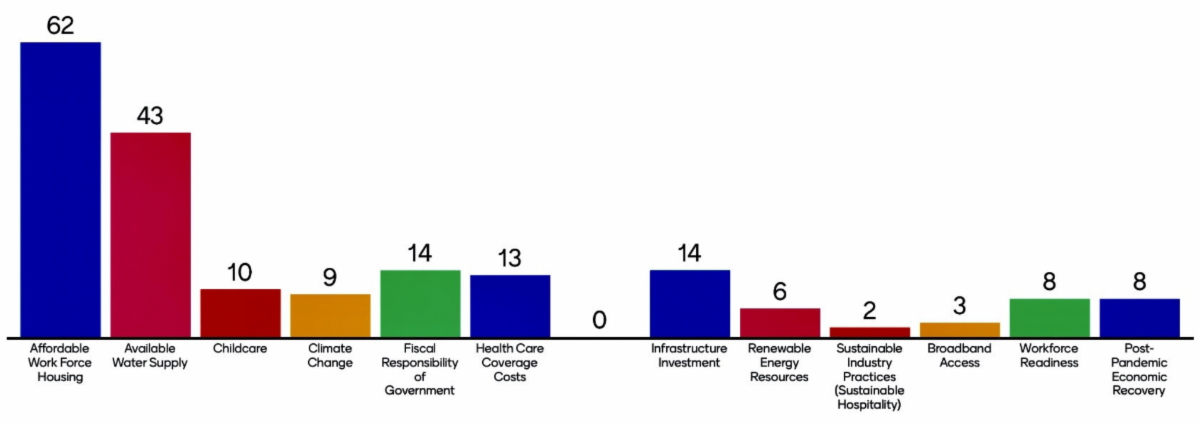
Attendees identified: 1. Affordable Work Force Housing and 2. Available Water Supply as the TWO key issue areas that are most important to prioritize for growing the regional economy and that will have the greatest impact on local business.
Summary of panelist remarks are as follows:
JIMMY PANETTA, U.S. HOUSE OF REPRESENTATIVES
Congressman Panetta discussed the importance of members of Congress knowing the needs of their district and building partnerships with local elected officials to fulfill those needs where federal involvement is appropriate. He quoted Benjamin Franklin regarding the role given by the U.S. Constitution to the House of Representatives on budgets and spending: “It was a maxim that those who feel, can best judge. This end would . . . be best attained, if money affairs were to be confined to the immediate representatives of the people.” He cited a bill he is preparing with U.S. Senator Ron Wyden to offer a “middle class housing tax credit” to help “people who work here but can’t afford to live here.” He listed various local projects receiving federal funding through the assistance of his office.
STATE SENATOR JOHN LAIRD
Senator Laird received praise from several speakers for his commentary in the Monterey Herald on future water supply. He noted his bill, enacted quickly into law, that established a health care public agency that could purchase Watsonville Community Hospital after it went bankrupt. He listed his initiatives for new spending programs to advance renewable energy and build housing for college students. Local projects receiving state funding through his office included a new Castroville Seawater Intrusion Project well, new valves at the Nacimiento and San Antonio dams, funding for the Shuman HeartHouse homeless shelter in Monterey, and the SURF! Bus Rapid Transit project.
MONTEREY COUNTY SUPERVISOR MARY ADAMS
Supervisor Adams said she was able to predict the top two issues identified in the survey as priorities for Chamber members: lack of housing affordable to ordinary people and inadequate water supply. She believes any new water availability must be reserved for affordable housing so local governments can meet their Regional Housing Needs Allocation targets.
She noted she supported two regional water forums. “Need to look beyond Monterey Peninsula for regional solutions.” Significant costs, regionalism may mean lower costs per person. Local funding will be needed. Cooperation among multiple agencies. California Department of Housing and Community Development (HCD) and State Water Resources Control Board (SWRCB) need to communicate more with each other.
MONTEREY COUNTY SUPERVISOR WENDY ROOT ASKEW
With the crisis response to COVID fading, she can now focus more on the issues that she campaigned on, such as affordable housing. Inclusionary housing is in the Monterey County Housing Element. In East Garrison, 66 affordable units are being included. She thanked Kathryn Avila for her involvement in housing policy issues. As a Monterey Peninsula Unified School District (MPUSD) board member, she was involved with investigating five sites for district workforce housing that have water credits. Teachers can’t afford housing on the Peninsula. She convened a first workshop on the Lead Me Home homeless plan and challenged county leaders to answer five key questions. She supports sanctioned encampments to serve as a safe legal place to sleep. She supports two big transportation projects: MST/TAMC’s SURF BRT and TAMC’s FORTAG.
MONTEREY COUNTY SUPERVISOR CHRIS LOPEZ
He thanked attendees for letting him pass through the Lettuce Curtain. He’s “looking for partners on Salinas Valley water” as “the water answer needs to be regional.” The Groundwater Sustainability Act laws requires basins to be balanced. We have to focus on “creating water” and that includes desalination. That water will lead to housing, which needs to be affordable. He cited the excessive cost of child care and expressed support for Measure Q. “We can do this at home in Monterey County” rather than waiting for the state or federal government to do it.
MONTEREY COUNTY SUPERVISOR JOHN PHILLIPS
It’s absurd to take down a dam and then declare you don’t need to replace the water that was stored there. We need to build a regional desalination plant, whether it’s seawater or brackish water, for the needs of Monterey Peninsula and the Salinas Valley. And build it for 9000 AFY and not 6000 AFY. We need to find a public or private entity to do it. Recycled water alone won’t allow CSIP to stop seawater intrusion and in North County we can’t even allow people to build an ADU. The switch mandated by the California Coastal Commission for the Cal Am desalination plant to use slant wells rather than direct intake helped delay the project, so now it’s ten years since Cal Am applied for the license.
MONTEREY COUNTY SUPERVISOR LUIS ALEJO
We need business leaders - not just politicians - to champion the effort to address homelessness. There is a lot of resistance, anger, and tension concerning this issue and right now the politicians bear the brunt. He is the co-chair of the regional Continuum of Care Leadership Council. Political will led to the construction and operation of the SHARE Center in Salinas, which serves a homeless population that is 2/3 women and children. Dozens of people who have gone to the SHARE Center have achieved permanent employment. Meanwhile, Casa de Noche Buena has now opened as the first homeless shelter in Seaside. King City is planning two homeless shelters and also a project for seniors. Other communities need to be part of this effort. His parents were missionaries and his father prayed from the perspective that “there but for the grace of God go I.” We need to humble ourselves.
JOHN THORNBURG, INTERIM UNDERSHERIFF
The Sheriff’s Office has to respond to calls related to incidents involving the homeless but does not enjoy the role of “the bad guy who comes in and takes stuff” from encampments. The county as a whole needs to work towards a solution for homelessness and not put the ultimate consequences on the Sheriff’s Office.
SAND CITY MAYOR MARY ANN CARBONE
Sand City will struggle to reach its Regional Housing Needs Allocation (RHNA) goals - not because they don’t have the water, but because they don’t have the space. The South of Tioga project, now under construction at last after years of permitting issues - will include “workforce housing” and low/middle income housing. Pure Water Monterey expansion will not be sufficient for reaching RHNA needs, contrary to supply and demand analyses, and we must build a regional desalination plant now.
PACIFIC GROVE MAYOR BILL PEAKE
Residents are saying “that’s crazy” about the Regional Housing Needs Allocation (RHNA) requiring 1000 new housing units. But this is the city’s opportunity to plan for more housing. How do we create a regulatory environment that encourages more housing? He was pleased with Senator Laird’s op-ed and the second Board of Supervisors water forum. We need a regional solution that includes desal as well as recycled water.
SEASIDE MAYOR IAN OGLESBY
He appreciates the Chamber’s leadership on economic development issues. He thanked Congressman Panetta for supporting federal funding to keep the city afloat during COVID. He gives credit to Supervisor Alejo to push at those Continuum of Care Leadership Council meetings to actually do something.
The City of Seaside has three water purveyors: Cal Am, Salinas Municipal Water Company, and Marina Coast Water District.
Regarding housing, the city has recently permitted 32-42 ADUs, with 30 on deck. In his opinion, to get affordable housing built around here you have to take the middleman (the developer) and profit out of it. Housing non-profits can build smaller projects and units and government can build affordable workforce housing. “You build for what people can afford, not build and then ask what you can afford.”
CARMEL CITY COUNCILMEMBER BOBBY RICHARDS
Carmel’s issues with affordable housing start with the city staff itself - three executive level positions they can’t fill. The city has permitted some existing buildings to become mixed use with second floor conversions from commercial to residential. In Carmel, lots are small and also not affordable for developers to tear down and rebuild. Workforce housing would be a desirable option.
SALINAS MAYOR KIMBLEY CRAIG
She thanked Salinas Rodeo leaders for attending. In the City of Salinas, affordable housing and homelessness are the top issues. The city has excellent partnerships now with the county on regional issues such as homelessness (the relationship used to be bad) and the SHARE Center is a great example of a recent successful relationship. Housing First means people without a home are more likely to accept wrap-around services.
Regarding water, the City of Salinas has a duty to protect the interests of the people of Salinas. Our water supply is scared - our community has paid into water improvements for decades. A discussion is needed about source water for Pure Water Monterey.
MONTEREY CITY COUNCILMEMBER ED SMITH
He noted that the City of Monterey has 550 inclusionary housing units at this time. The role of local government has changed over the past 30 years. He noted Monterey experiences what author Stephen Covey described as institutional difficulties balancing a “circle of concern” (the complete range of human worries) with a “circle of influence” (worries we can actually do something about, directly or indirectly). The city manager has a new five-year contract, the city wants to keep dining on Fisherman’s Wharf despite a threat from the California Coastal Commission, and this event shows the success of the new Monterey Conference Center.
DEL REY OAKS MAYOR ALISON KERR
In Del Rey Oaks, Cal Am and Marina Coast Water District are the two water purveyors. There is limited property in the old city limits so no housing will be built there. Fort Ord parcels are our future for housing. We have water there. She is from a family of teachers, and 1 of every 4 teachers must leave area.
Pure Water Monterey will allow us to meet our short, medium, and long term goals. She’s meeting with Stoldt about his water supply and demand analysis [which confirms PWM will be sufficient].
Attendees at this luncheon have a role in housing - you need to pay living wages so our working families can support themselves.
By 12 votes, Del Rey Oaks voters chose to save FORTAG. She supports FORTAG and is proud that DRO is the first place where it will be built.
MARINA CITY COUNCILWOMAN CRISTINA MEDINA DIRKSEN
After thanking the banquet room servers, the Marina Chief of Police Tina Nieto (in attendance), and the Chamber, Councilwoman Dirksen declared that “water is deeply dividing us” and asserted that “desal will affect our water supply” in the City of Marina. We ALL require a seat at that table” for future water supply planning. 2250 AFY for PWM will meet our future needs for 1% growth.
Expansion can do it now. Technology for the desal plant is flawed. It’s “questionable technology.”
In the City of Marina, 62% of children receive free/reduced lunches at MPUSD. Most of the workers are in agriculture and hospitality. It’s economic injustice to have their water source at home threatened to produce water to send elsewhere.
MONTEREY PENINSULA AIRPORT BOARD MEMBER CARL MILLER
No plans to build housing at the airport.
The airport has potential water sources from on-site wells that will be used for new terminal. They will switch some water supply from Cal Am to on-site wells.
People who fly to the Monterey Peninsula spend more money and stay longer, generating more than $300 million in revenue. Number of air travelers dropped from 22,000 monthly to 601 monthly when COVID hit. Now back at pre-pandemic with 5 airlines and multiple destinations. Bigger aircraft coming in. More destinations and a new terminal coming - thank you Panetta for federal funding for terminal. There is potential for more partnerships with business community.
|