|
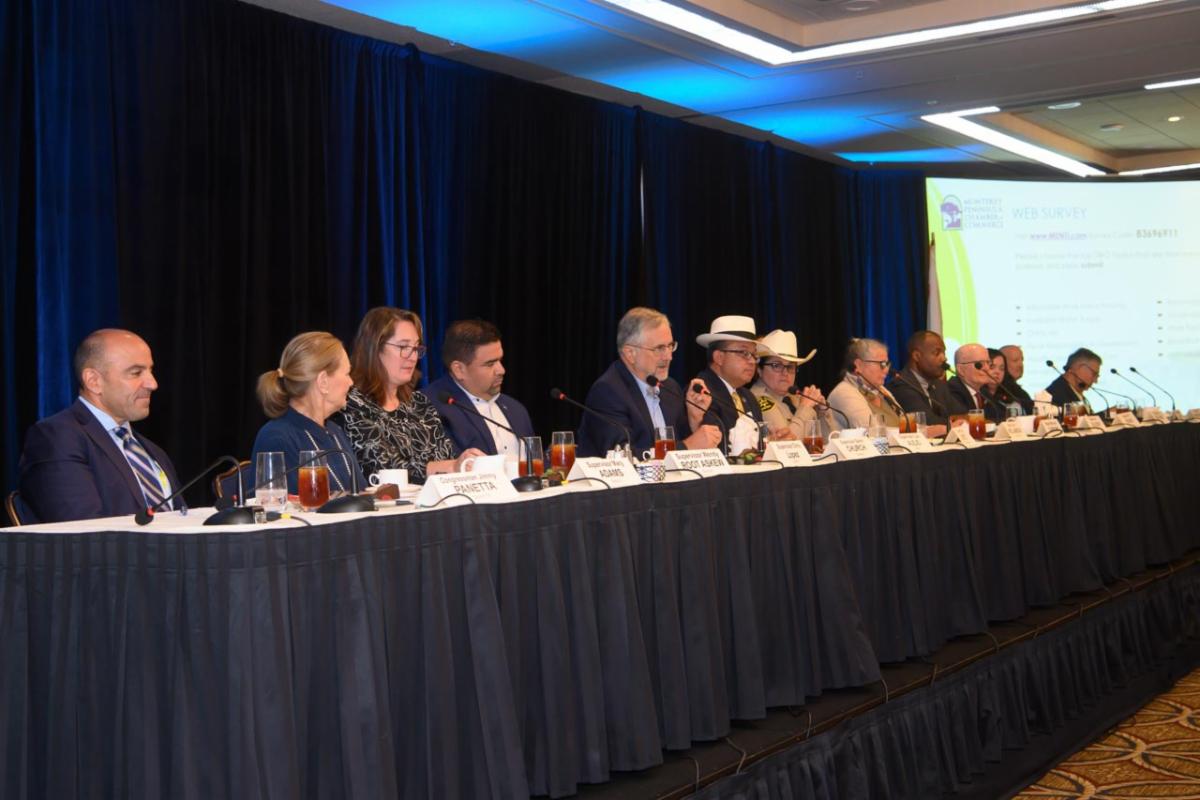
RECAP: Fourteen Elected Officials Speak at Chamber’s Annual Leadership Luncheon
|
 |
|
The 2023 annual survey of Leadership Luncheon attendees determined - as usual - that the top two issues facing the Monterey Peninsula business community are inadequate water supply and lack of housing that’s affordable for ordinary people.
- U.S. Representative Jimmy Panetta recognized the Chamber for its advocacy in support of economic development. He praised the service of local government officials on the panel and noted the strong partnerships and relationships between layers of governments in Monterey County. He commented on the challenges of being in Washington, DC, where he want to be “in the legislation business, not the entertainment business.” After listing highlights of his priorities, including federal grants for local projects and his support for multiple housing bills, he expressed concern about how a solid majority of Americans appears to have negative views about the country despite evidence that the economy and other social conditions are relatively good. His response is to keep getting things done in Congress.
- Monterey County District 5 Supervisor Mary Adams remembered the late North Monterey County Supervisor Lou Calcagno. She acknowledged the challenges of the County of Monterey and the county’s cities in achieving their state-mandated Regional Housing Needs Allocation (RHNA) goals in the Housing Elements of their General Plans. To address the shortage of housing affordable to ordinary people, she called for construction of more multi-unit rental developments, employee/workforce housing, infill development, individual units for unhoused people, enforcing laws against housing discrimination, prohibiting short-term rentals, promoting Accessory Dwelling Units (ADUs), and infrastructure for water supply and escape routes from wildfires.
- Monterey County District 4 Supervisor Wendy Root Askew pursues collaboration as a central theme in her public service. The County has several new senior management officials and a new Communications officer. She continues her focus on overseeing the largest aspect of county government - health and social services - and cited examples of funding for new social service facilities in Marina and Seaside. Exciting developments in her district include the Imjin Road Improvement Project and expansion of research and development at Joby Aviation.
- Monterey County District 3 Supervisor Chris Lopez wants local governments to “pull in the same direction in partnership” to tackle what he considers to be the top three issues in his South County district and beyond: housing supply, water supply, and infrastructure improvements. He thanked Chamber members for leadership on housing and energy and recognized Natividad as a successful county hospital.
- Monterey County District 2 Supervisor Glenn Church recognized the late North County Supervisor Lou Calcagno, giving particular praise to Supervisor Calcagno’s institutional memory and his ability to remember the past when considering how to plan for the future. He noted that two major issues for his district - lack of affordable housing and unhoused people - have their origins in decisions made several decades ago. In the name of redevelopment, governments demolished or repurposed buildings such as boarding houses and hotels where people on the margins lived. Also over time, more stringent building safety standards and the tendency of developers to build bigger houses increased prices. “You can’t build a more affordable house by making it bigger.” He called for construction of smaller houses and Accessory Dwelling Units (ADUs).
- Monterey County District 1 Supervisor Luis Alejo said that making real efforts to address affordable housing and homelessness requires political will and political courage. “It’s easy to say no” as an elected official when opponents of housing show up at meetings. If the County of Monterey and its cities can’t make progress on achieving their Regional Housing Needs Allocation new housing goals, the County will lose economic opportunities and future tax revenue. Joby Aviation found that the lack of housing was a liability in Monterey County when it considered where to locate a large manufacturing facility. Our region needs to especially focus on housing opportunities in disadvantaged communities in the unincorporated county such as Pajaro, Castroville, Las Lomas, and San Lucas.
- Monterey County Sheriff Tina Nieto wants to improve public safety through fiscal responsibility: allocating limited funds to more personnel who can respond to business concerns such as crime and safety, instead of unnecessarily spending money on litigation defending the Sheriff’s Office. She reported that the high cost of Monterey County housing is detrimental to recruitment and retention of employees of the Sheriff’s Office.
- City of Monterey Mayor Tyller Williamson said that the city is participating in regional water supply solutions through a plan to divert excess water from Lake El Estero to the Monterey One Water (M1W) Regional Treatment Plant for recycling into drinking water. This could produce as much as 180 acre-feet per year (AFY) that the city hopes can be allocated as credits to build affordable housing. There may also be opportunities for a partnership with Naval Support Activity Monterey to divert and recycle excess water from Del Monte Lake and for a partnership with the City of Seaside to divert and recycle excess water from Roberts Lake. While increasing water supply, the City of Monterey is also planning to increasing housing supply with a new Housing Element that reduces government obstacles and burdens “so developers can do their job.” He urged supporters of more housing to come to city council meetings and speak in support of it.
- Sand City Mayor Mary Ann Carbone reported that Sand City is working to reduce government regulations and provide incentives so more housing is built. Sand City is applying for a “pro-housing designation” from the State of California that will help streamline the project approval process. The city is focused on the potential of building mixed-use density housing for the so-called “missing middle” (people who aren’t poor but can’t afford market rate housing) on four non-contiguous land parcels. The approved South of Tioga development will add 356 new residential units, including 52 units allocated as affordable.
- City of Pacific Grove Mayor Bill Peake reported that the city has been operating its own water recycling facility since 2018 that has allowed water to be allocated for housing construction, including Accessory Dwelling Units (ADUs). The city’s long-term ability to attract affordable housing development requires water, land, and money, and hopefully the Pure Water Monterey project and its expansion will increase supply enough for the State Water Resources Control Board to lift its moratorium on new water connections. Meanwhile, two new hotels are planned: the Pacific Grove Hotel in downtown and a hotel at the site of the American Tin Cannery, a proposal that the California Coastal Commission is now evaluating.
- City of Seaside Mayor Ian Oglesby declared that “water is the problem.” At some point the region can hopefully get enough water supply for the State Water Resources Control Board to allow new water connections, which will allow housing development in the city’s downtown and elsewhere for all income levels. He especially wants to focus on the neglected “missing middle,” workforce housing, and smaller units for seniors. Regional water supply deficiency and its consequences for housing and economic development pushes smart young people to leave the area and results in constant turnover of teachers at the Monterey Peninsula Unified School District and the local health care system.
- City of Salinas Mayor Kimbley Craig stated that the Chamber’s Leadership Luncheon was one of her favorite annual events because “the audience picks the topic” for speakers. The City of Salinas is a contributor to regional recycled water solutions from several sources, including “ag-wash” water from the city’s own Industrial Wastewater Treatment Plant. The Salinas City Council has three areas of focus right now: homelessness, affordable housing, and street and sidewalk improvements. The city has an “inclusionary” housing requirement for developers to set aside 20% of their units for affordable allocation. It is in “a conversation” about building mixed-use density housing in Downtown. And the city issued about 200 permits in 2022 for construction of Accessory Dwelling Units (ADUs) and issued 74 certificates of occupancy for ADUs. The city also has a plan for a future growth area that could result in 50,000 more units, with discussions ongoing about what those units will be. Finally, Mayor Craig urged attendees to abandon “Lettuce Curtain” terminology and mentality, which perpetuates a false idea that the Salinas Valley and Monterey Peninsula are separate, segregated worlds and not intertwined economically and socially.
- City of Del Rey Oaks Mayor Scott Donaldson reported that his city has settled lawsuits trying to block roads and housing. It is now planning to upgrade and improve South Boundary Road, including with a roundabout at its intersection with General Jim Moore Boulevard. This will facilitate infrastructure needs for new housing. The city has water available from the Marina Coast Water District to build housing in that area. It wants to work in collaboration with the cities of Seaside and Monterey to obtain funding for this project, including from the new federal Defense Community Infrastructure Pilot Program.
- Monterey Peninsula Airport District Division 4 Board Member Carl Miller informed the audience that Monterey Peninsula Airport was the first special district airport in California, and it has its own board of directors elected by the people. Over the past twenty years, aircraft using the airport have become bigger, quieter, and travel farther to destinations. The airport district is proceeding with a $170 million new terminal that will be funded by the Federal Aviation Administration (FAA) with passenger user fees. A solar farm produces almost all power for the district; it will be expanded for the new terminal. In addition, the district has identified five sources of water for the airport. Its vehicle wash facility will soon be disconnected from the Cal Am system, and the new terminal will have its own gray water recycling system.
|
|
|
TOMORROW: MPCC Mixer hosted by Habitat for Humanity Monterey Bay
Mix, mingle, and network with local nonprofits and members of the business community at tomorrow's Mixer!
$10 for Members, $20 for Prospective Members
|
|
|
Join the 2024 MPCC Board of Directors
Nominations are now open for the 2024 Monterey Peninsula Chamber of Commerce Board of Directors. The call for nominations presents an opportunity for community members to take on leadership roles that directly impact the local business community.
If you would like to nominate yourself or someone else to the Board, please contact Monica Lal at monica@montereychamber.com. The nominating committee will meet to review all nominations. Deadline to apply is September 30, 2023.
|
|
|
SPACES ARE FILLING UP - We want to feature YOU!
The Monterey Peninsula Chamber of Commerce is looking to feature Member Businesses on Instagram Reels! This is a no-cost marketing opportunity available exclusivley to MPCC Members. Fill out this form to request a Member Reel on our MPCC Instagram Page. Please allow two weeks for scheduling.
|
|
Please forward this e-blast to your colleagues, customers, clients, friends, family and fellow community members!
|
|
|
|
|
|