|
Meet the Steelhead
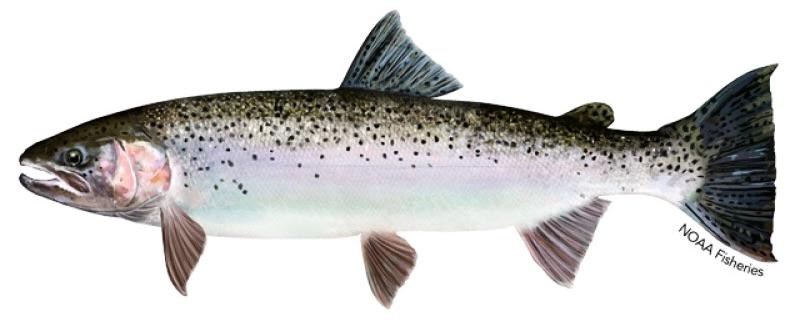
Steelhead are sometimes cited as a reason for water policy implementation in Monterey County, including restrictions of Carmel River surface water diversion for the Aquifer Storage and Recovery (ASR) project, limits on groundwater production from wells in the Carmel River Alluvial Aquifer, and dry season releases of water from reservoirs to the Salinas River. But what are steelhead? Put simply, steelhead are fish classified in the salmonid family, which includes salmon, trout, char, and whitefish. On the East Coast, the steelhead is commonly called "rainbow trout" and lives exclusively in freshwater. On the West Coast, the steelhead is an "anadromous" fish, in other words, adults live in salt water (the ocean) but migrate to fresh water rivers and tributaries to spawn. Then they go back to the ocean. Juvenile fish hatch from eggs and then later migrate to the ocean themselves.
That migratory behavior is the basis for government and public concern about inadequate surface flow in the Carmel River and Salinas River (and other West Coast rivers) caused by droughts, dams, and pumping of surface and alluvial aquifer river water. The National Oceanic and Atmospheric Administration (NOAA) National Marine Fisheries Service (NMFS), part of the U.S. Department of Commerce, lists 28 species of West Coast salmonids as threatened or endangered under the federal Endangered Species Act (ESA). The steelhead was designated as threatened in 1997. NOAA Fisheries works with the California Department of Fish and Wildlife (CDFW) to protect and restore wild populations of salmonids.
In 1990, the Monterey Peninsula Water Management District (MPWMD) approved a Water Allocation Program that included a new Mitigation Program to restore steelhead populations. It continues today with steelhead rescue programs (more than 500,000 rescued since 1989) and the Sleepy Hollow Steelhead Rearing Facility near Carmel Valley Village. MPWMD and its contractors and partners have been saving steelhead by scooping them into buckets and transporting them to the Carmel River lagoon or to upstream areas of the Carmel River that have water. Rescues occur in the summer and fall for juveniles and in the spring for smolt (two year old salmonids that are ready to migrate to the ocean).
The Carmel River Steelhead Association (CRSA) was one of the parties whose complaints resulted in the 1995 State Water Resources Control Board (SWRCB) order declaring that California American Water Company (Cal Am) must stop extracting groundwater from the Carmel Valley Alluvial Aquifer in excess of its water rights. A series of drought years and water diversions from Cal Am and other groundwater users had reduced steelhead populations in the Carmel River to almost nothing. When the SWRCB imposed a Cease and Desist Order in 2009 and prohibited new water connections, intervenors included the CRSA, NMFS, the California Sportfishing Protection Alliance, and the California Salmon and Steelhead Association. NMFS supports demolition of the one remaining dam on the Carmel River, the Los Padres Dam, to improve steelhead migration.
In 2001, NMFS and Cal Am entered into an agreement that required Cal-Am to implement certain measures to reduce the impact of its operations in the Carmel River on steelhead and their habitat. A new agreement for steelhead protection was reached in 2009 with NMFS, Cal Am, and also CDFW. In 2017, Cal Am signed another agreement with NMFS and the California State Coastal Conservancy for further investigation into options to protect steelhead.
NMFS has also designated the Salinas River as critical habitat for steelhead. Dams in southern Monterey County (which created the Nacimiento Reservoir and the San Antonio Reservoir) and a dam in San Luis Obispo County (the Salinas or Santa Margarita Dam) have inhibited fish passage, and lack of surface water from droughts and pumping of groundwater from the Salinas River Basin have also reduced the steelhead population. The Monterey County Water Resources Agency (MCWRA) regularly releases water from the Nacimiento and San Antonio reservoirs to maintain enough water in the river for steelhead, even when drought conditions prevent releases of water for agricultural irrigation. MCWRA is developing a Salinas River Habitat Conservation Plan, based on a 2019 Salinas River Long-Term Management Plan. The Resource Conservation District of Monterey County (RCDMC) is also involved with steelhead protection in the Salinas River.
|