|
Local Government Leaders Discuss Budget Issues at the 24th Annual Leadership Luncheon
Your Chamber’s Annual Leadership Luncheon (now ongoing for 24 years) provides an opportunity for government officials and community leaders to “create possibilities, shift perspectives, and find solutions.”
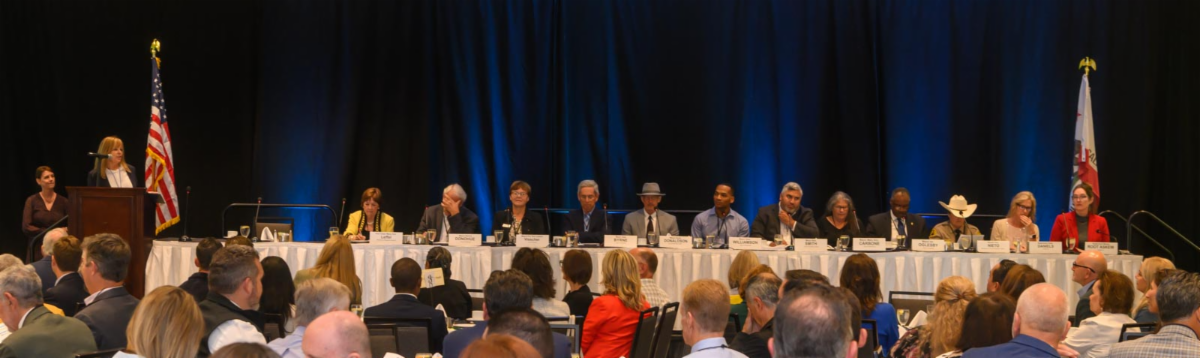
Attendees of the 2024 Leadership Luncheon, presented by Mechanics Bank, heard local government officials talk about housing affordability for the local workforce. Attendees of the 2025 Leadership Luncheon heard about their plans for economic development.
At last week’s Leadership Luncheon (held on September 18, 2026) panelists were asked to explain their principles and strategy to balance their local government's budget in the next five years. Below is a summary of answers from the panelists.
- Monterey County Supervisor Wendy Root Askew focused on an overlooked aspect of local government: regional boards and commissions. She's on three regional boards dealing with tough budget decisions: ReGen Monterey (the former Monterey Regional Waste Management District), the Monterey Bay Air Resources District (MBARD), and Central Coast Alliance for Health (CCAH). ReGen Monterey and MBARD have to balance fulfilling their roles with public distaste for fee increases. CCAH is a managed care health plan that provides Medi-Cal coverage to eligible residents, and its members are bearing the brunt of spending cuts and new regulations from H.R. 1 (2025), the "One Big Beautiful Bill Act."
- Monterey County Supervisor Kate Daniels said that approving the budget is the most important thing the County Board of Supervisors does each year. Up to this year, the board and staff have devised clever one-time tactics to delay the inevitable time to make tough decisions about the county's structural budget deficit. This year was different, as staff took the lead to identify permanent changes in spending and personnel while maintaining essential services. The county is evaluating potential savings through an evaluation of its buildings.
- Monterey County Sheriff Tina Nieto was asked a slightly different question: What plan does the Sheriff's Office have to control costs and avoid mid-year requests for additional funding for the current fiscal year? She noted that the department must fulfill many federal and state mandates, and people who are arrested by the sheriff's department generally do not generate revenue to pay for services. The department is looking at eliminating long-vacant positions, managing overtime, aggressively seeking federal and state grants, and trying to find ways to control expenses for mandated inmate health care services at the county jail.
- Seaside Mayor Ian Oglesby told the story of a recent difficult budget decision by the city council. The city was looking at cutting back on services this year because of cost increases and revenue reductions resulting from national issues outside of its control. Typically cities will cut discretionary youth programs, parks and recreation, and senior services. The city council instead decided their current expenditures were important enough to maintain for another year by using the city's reserve fund. "Reserves are not just for the employees - they're for the community."
- Sand City Mayor Mary Ann Carbone reported that her city is in a good financial position but will continue to budget conservatively. She challenged board members of regional agencies not to ignore rising costs for those agencies but to be cautious of rate and fee increases when many residents are struggling with those same rising costs. She is pleased that the Monterey One Water (M1W) wastewater treatment and recycling agency has a more comprehensive financial assistance program now. The new Sabu Shake, Sr. Good Samaritan Center in Sand City has supplemented government assistance to residents in need with its own assistance programs.
- Pacific Grove Mayor Nick Smith contended that the Chamber's question about budgets and fiscal responsibility is "at the center of what we're doing." He reported that his city has converted to a two-year biannual budget cycle as a planning strategy, but in practice each year is a different exercise based on issues of the moment. He emphasized that the city needs to focus on essential services. He also noted that economic development and more people engaging in commerce (in places such as in Downtown) helps the city as it balances its budget each year.
- Monterey Mayor Tyller Williamson says that his city has focused on building reserves since 2018 through a Fiscal Health Response Plan and now also has special reserve policies for the conference center, library, public safety, information technology, the sports center, and preparing for sea level rise. He wants to address the city's structural budget deficit by keeping services with in-house employees instead of contracting out, working closely with the city's special business districts, moving forward with an economic development strategy, and advancing the city's Roadmap to Resiliency, which will determine public sentiment on ways to increase revenue and limit expenditures.
- Del Rey Oaks Mayor Scott Donaldson noted that his city has flirted with municipal bankruptcy in the past but now is in excellent fiscal shape with strong reserves. The city saved all revenue collected from cannabis taxes after it approved dispensaries. The city is expecting flat revenue and increasing operational costs in the coming years and is looking toward potential development of its Fort Ord parcel to maintain fiscal stability.
- Carmel Mayor Dale Byrne reported a dramatic change in city budget priorities, as earlier city councils were spending all of the budget on services and none on streets and sidewalks, infrastructure, and building maintenance. It showed. While the city does not have debt, it will pay inflated construction costs to make up for years of deferred maintenance.
- Marina City Councilmember Liesbeth Visscher declared "we need to make sure we pay for growth with new development" and "attract investment and jobs." She supports the city's proposed restoration of a long-expired utility tax, which voters will consider on the November ballot as Measure Q. This will pay for new city facilities to replace outdated and inadequate structures such as the trailers used as the civic center.
- Salinas Mayor Dennis Donohue noted that he liked the question because it leads to his favorite answer: "it depends." The city has adopted a two-year biannual budget that helps with planning. At the center of the city's fiscal future is voter consideration of renewal of the 2014 Measure G sales tax, on the November ballot as Measure G. Despite the significant new revenue expected from the new Amazon distribution center, the loss of Measure G revenue would be a serious blow. In the meantime, the city is looking for more revenue through economic development (especially related to ag tech, the train station in Downtown, and sports venues such as the new Soccer Complex). To address infrastructure needs, the city is pursuing use of public-private partnerships (P3s).
- Monterey Peninsula Airport District Board Member MaryAnn Leffel was asked a slightly different question: Has the airport planned for unexpected economic and political developments that could affect its ability to repay debt? She reported that the airport is in "great shape" fiscally. Expenses are entirely paid by passenger fees, so it's important to offer flights desired by the public. The loan for the airport improvements is at an outstanding 2.5 percent interest rate because it's through the federal TIFIA (Transportation Infrastructure Finance and Innovation Act) program. She also noted that a recent economic impact study credited the airport with $597 million in local economic benefit and 1500 local jobs.
|
|
|
|
|
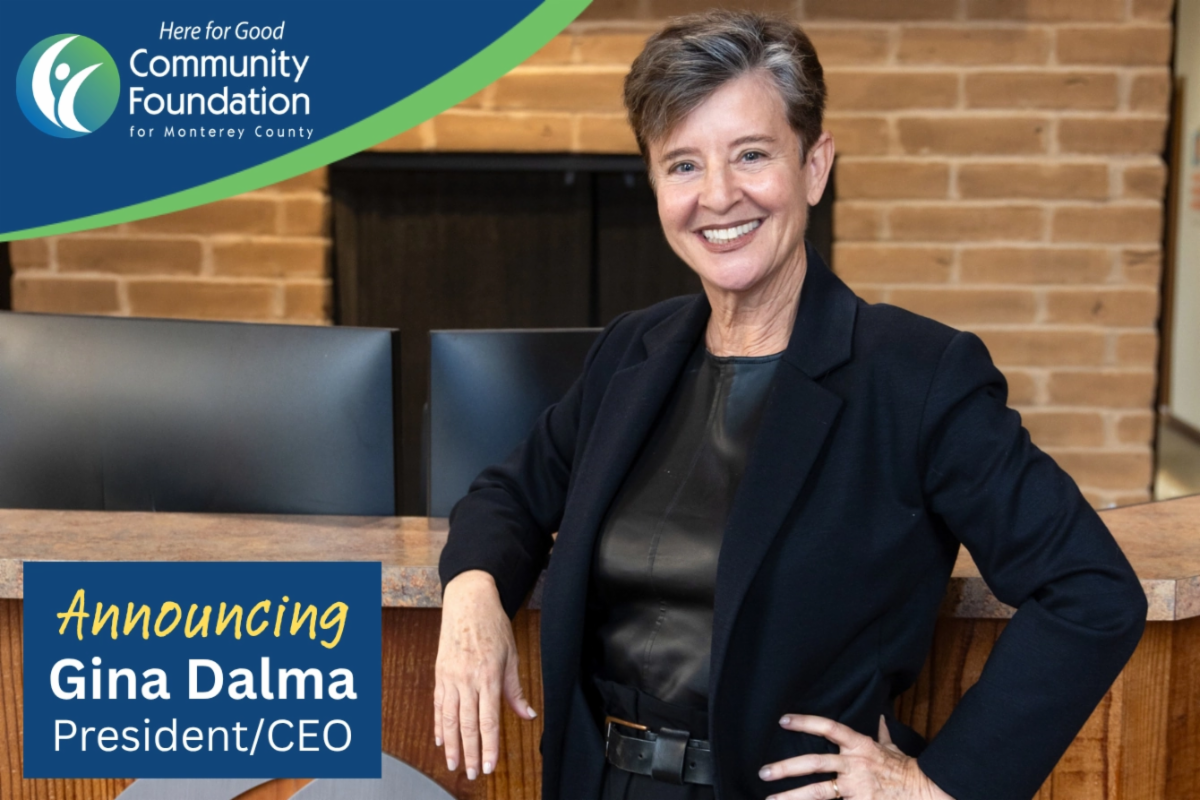
Community Foundation for Monterey County Announces Next President/CEO - Gina Dalma
The Community Foundation for Monterey County (CFMC) is pleased to announce its next President/CEO, Gina Dalma. “The Community Foundation for Monterey County has completed a national search and selected a new leader who is exceptionally well-qualified, deeply aligned with our mission and committed to engaging authentically with our communities,” said Board Chair Elsa Mendoza Jimenez.
Gina Dalma is a philanthropic executive with more than 20 years’ experience working at the intersection of strategic philanthropy, public policy and donor development to bring about systems change. Most recently, she served as Chief Development Officer for the Global Fund for a New Economy, where she spearheaded donor engagement, organizing and fundraising strategies to mobilize capital for global economic inclusion, equity and sustainability. Prior to that, she served nearly 16 years at the Silicon Valley Community Foundation in a variety of roles, most recently as Executive Vice President of Community Action, Policy and Strategy, leading the foundation’s impact and grantmaking work
|
|
|
|
|
For over 35 years, Adventures by the Sea has been giving visitors and locals the opportunity to discover Monterey by land and by sea! With five locations throughout the Monterey Peninsula, their shops put you right in the heart of the action, making it easy to start exploring without wasting time getting there. Whether you’re hoping to spot sea otters from a kayak or cruise the Monterey Bay Coastal Recreation Trail by bike, Adventures by the Sea offers the perfect starting point.
From kayak and bike rentals and tours to family bikes (or surreys), stand-up paddleboards, lessons, and more, Adventures by the Sea has everything you need to get outside and experience the Monterey Peninsula. Whatever your adventure, their team can help you gear up, get going, and make the most of your time on the beautiful Monterey Bay.
|
|
|
|
Thank You to our MPCC Leadership Circle!
|
|
Please forward this e-blast to your colleagues, customers, clients, friends, family and fellow community members!
|
|
|
|
|
|